
Key Takeaways
- Distortion is managed across the whole chain: laser cutting, bending, weld sequence, straightening and coating, not at the welding step alone.
- Plan for springback in bending: stainless steel springs back more than mild steel, so tooling over-bends to reach the target angle.
- Weld symmetrically and alternately, use tack welds and fixtures, and keep weld size no larger than the drawing needs.
- Leave machining stock on mounting faces of heavy brackets and finish-machine after welding and stress relief.
- Choose powder coating or galvanizing early: hot-dip galvanizing needs vent holes and can distort thin sheet.
Custom sheet metal enclosures and heavy welded brackets are formed by heat and force, and both leave residual stress. The result is distortion unless the process is planned from cutting to coating. The sequence below reflects how we organize fiber laser cutting, CNC press brake bending and automated gantry and rotary-positioner welding at our Qingdao workshop.
1. Laser cutting: a good start for fit-up
Fiber laser cutting gives narrow kerfs and small heat-affected zones, which keeps flat blanks accurate for bending and fit-up. Nitrogen-assisted cutting leaves an oxide-free edge that suits stainless steel and parts that will be powder coated; oxygen cutting is common for thicker mild steel. Tab-and-slot features let parts locate each other, which reduces fixture cost and welding gaps.
2. Bending and springback compensation
After the load is released, bent sheet springs back slightly. Air bending in mild steel typically springs back by one to two degrees, and stainless steel springs back more, so the press brake over-bends to hit the target angle. Good design rules help: use an inside radius of about 1× the sheet thickness in mild steel and more in stainless steel, keep holes at least about 2.5× thickness plus the bend radius away from a bend line, and avoid flanges shorter than roughly 4× thickness.
3. TIG and MIG welding sequence control
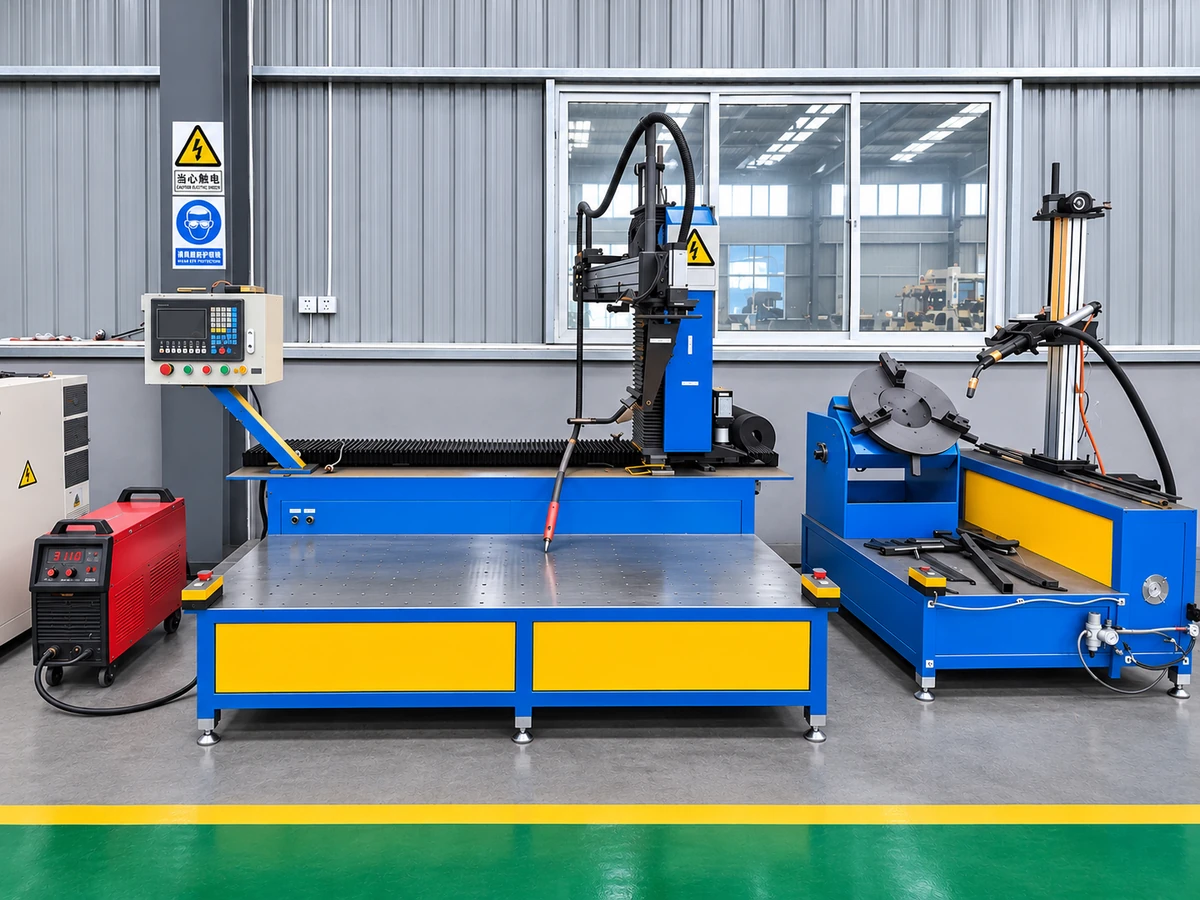
Weld heat shrinks the joint, so the order matters as much as the process. Tack the assembly in a fixture, then weld alternately on opposite sides and from the centre outward, using back-step or skip welding on long seams. Keep the weld leg size to what the load requires, because oversized welds add shrinkage. TIG suits thin stainless steel and visible seams; MIG suits thicker carbon steel brackets where deposition rate counts. Robotic gantry welding with a rotary positioner keeps travel speed and torch angle repeatable on batch work.
| Stage | Distortion risk | Control measure |
|---|---|---|
| Laser cutting | Edge heat, blank inaccuracy | Fiber laser, nitrogen for clean edges, tab-and-slot locating |
| Bending | Springback, angle scatter | Over-bend compensation, consistent grain direction and radius |
| Welding | Shrinkage, angular distortion | Fixtures, tack welds, symmetric / skip sequence, right-sized welds |
| Straightening | Residual bow or twist | Press or local heat straightening, stress relief on heavy parts |
| Finish machining | Mounting faces out of position | Machining stock on faces and bores, post-weld milling and boring |
| Coating | Zinc bath or cure heat, trapped fluid | Vent / drain holes, correct pre-treatment, seal-weld where required |
4. Post-weld straightening and stress relief
Even with a controlled sequence, large frames can show bow or twist. Press straightening or controlled local heating brings them back, and heavy carbon steel weldments may be stress relieved before final machining. For heavy brackets with tight mounting accuracy, we leave stock on the faces and bores and perform post-weld CNC milling and boring, holding critical tolerances down to ±0.01 mm.
5. Surface treatment: powder coating and galvanizing
For powder coating, shot blasting or phosphating removes scale and oil, and the coating is typically 60–100 µm thick. Seal-weld or vent any closed gap so that cleaning fluid is not trapped. Hot-dip galvanizing gives thick zinc protection (ISO 1461 sets minimum average coating thickness by steel thickness, from 45 µm on thin sections to 85 µm over 6 mm), but the part must have vent and drain holes, and thin sheet can distort in the roughly 450 °C zinc bath. Zinc plating is a thin coating for small hardware. Black e-coating suits indoor and automotive parts. State your corrosion environment so the right process is chosen.
Sourcing FAQ
How much does a weldment usually distort, and can it be guaranteed flat?
Distortion depends on thickness, weld length, joint design and sequence, so no honest supplier gives a universal figure. Control comes from balanced welding sequences, fixtures, straightening and, for mounting faces, finish machining after welding. State flatness and hole-position requirements on the drawing so the process can be planned around them.
Should I specify TIG or MIG welding for my enclosure?
TIG gives a cleaner, lower-heat weld and suits thin stainless steel or visible seams. MIG deposits faster and suits thicker carbon steel brackets and frames. Tell us which seams are cosmetic and which are structural, and we will assign the process by seam rather than by part.
Powder coating or hot-dip galvanizing for outdoor welded parts?
Powder coating over a blasted or phosphated surface gives colour and good appearance for enclosures and light brackets. Hot-dip galvanizing gives thick sacrificial protection for heavy structural parts but needs vent and drain holes and may distort thin sheet because the zinc bath runs at about 450 °C. Electro-galvanizing is a thinner option for small hardware.
Next step: send your drawings for an engineering review and quote
Upload your files through Request a Quote (PDF, STEP/STP, IGES/IGS, DXF, JPG/PNG), or send drawings and photos on WhatsApp (+8613964269123) for a fast feasibility check. You can also email sales@xshuntai.com. Our engineers give DFM feedback before quoting; standard batch lead time is 35–40 days, confirmed against drawing and quantity.