Key Takeaways
- Q355B (minimum yield about 355 MPa) is the default for welded hitch frames, tow-bar bodies and agricultural brackets: weldable, tough and economical.
- 4140 alloy steel (Chinese equivalent 42CrMo) is for heat-treated pins, shafts and ball studs where strength and fatigue life matter more than weldability.
- Quenched and tempered 4140 can exceed 650 MPa yield, but welding needs preheat and controlled cooling.
- A hybrid design, with a welded Q355B structure and machined 4140 pins, often gives the best cost and safety balance.
- Send operating load, hardness target and surface finish with the drawing so the material and heat treatment can be confirmed at quotation.
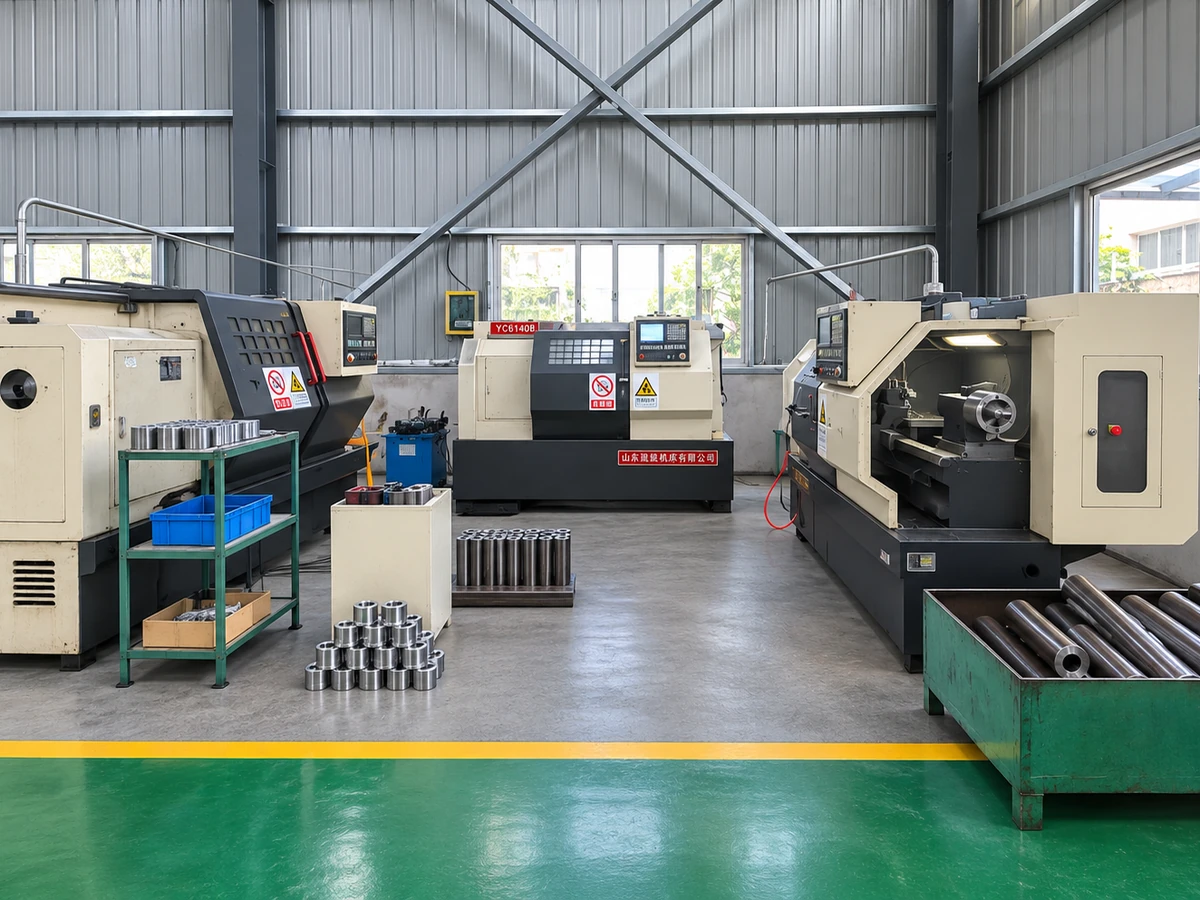
Trailer hitches, tow bars and tractor three-point hitch parts take shock loads, wear at pivots and exposure to weather. Choosing between Q355B structural steel and 4140 alloy steel is one of the most common decisions in the hitch and agricultural parts we weld and machine at our Qingdao factory. The summary below helps buyers specify the right grade.
Q355B: the structural workhorse
Q355B is a low-alloy structural steel (GB/T 1591) with a minimum yield strength of about 355 MPa for sections up to 16 mm, tensile strength around 470–630 MPa, and a B-grade impact requirement at +20 °C. Its low carbon equivalent makes it easy to cut, bend and weld with MIG, so it is well suited to A-frames, hitch receivers, brackets, guards and mounting plates. It is used as supplied; it is not meant to be through-hardened.
4140: the heat-treated strength grade
4140 is a chromium-molybdenum steel (the closest Chinese grade is 42CrMo). It is typically supplied annealed or pre-hardened and then quenched and tempered to a target hardness. After heat treatment it offers high yield strength, good fatigue resistance and good wear performance, which suits pivot pins, ball studs, shafts and coupling hardware. Its higher carbon equivalent makes welding difficult, so it should be welded only with preheat, low-hydrogen consumables and slow cooling, or designed as a machined, non-welded component.
| Property | Q355B | 4140 annealed | 4140 quenched & tempered |
|---|---|---|---|
| Typical yield strength | 355 MPa min. (up to 16 mm) | about 415 MPa | about 655–930 MPa, depending on temper |
| Typical tensile strength | 470–630 MPa | about 655 MPa | about 850–1,000 MPa or more |
| Weldability | Good, usually no preheat for thin sections | Poor; preheat and post-weld treatment | Poor; avoid welding after hardening |
| Heat treatment response | Not hardened; normalized if needed | Hardenable | Delivered at target HRC |
| Machinability | Good | Good | Reduced at high hardness |
| Typical use | Welded frames, brackets, hitch bodies | Blanks for machining | Pins, shafts, ball studs |
| Relative cost | Lower | Higher | Highest (adds heat treatment) |
Values are typical reference figures; confirm the exact specification and certificate requirements in your RFQ.
How to choose
Use Q355B when the part is a welded structure with moderate stress and the main risks are impact and weather. Use 4140 when a pin, shaft or ball stud carries high bending or shear loads, needs a specified hardness, or wears against a mating part. When both are needed, weld the Q355B body and bolt or press-fit machined 4140 inserts, then finish with powder coating, zinc plating or black oxide as required. Mention the rated load, hardness range and test method in your request, as validation against your market's standards stays with the buyer's design.
Sourcing FAQ
Is 4140 alloy steel stronger than Q355B, and should I always use it?
Quenched and tempered 4140 can reach far higher yield strength than Q355B, but it is harder to weld, needs heat treatment and costs more. Q355B is the practical choice for welded frames, brackets and hitch bodies; 4140 (or its Chinese equivalent 42CrMo) is for heat-treated pins, shafts and highly stressed machined parts.
Can 4140 be welded to a Q355B structure?
It is possible but needs controlled procedures: preheat (typically in the 200–300 °C range), low-hydrogen consumables and slow cooling, often with post-weld heat treatment. A better design is to make the 4140 part a machined pin or insert that is bolted or fitted, and weld only the Q355B structure.
Who is responsible for load rating of a hitch or implement part?
We manufacture to your drawing and specification and can supply first-article inspection and dimensional reports. Rated load and compliance with the standards of your market are part of the buyer's design validation, so share the required rating, hardness and test method when you request a quote.
Next step: send your drawings for an engineering review and quote
Upload your files through Request a Quote (PDF, STEP/STP, IGES/IGS, DXF, JPG/PNG), or send drawings and photos on WhatsApp (+8613964269123) for a fast feasibility check. You can also email sales@xshuntai.com. Our engineers give DFM feedback before quoting; standard batch lead time is 35–40 days, confirmed against drawing and quantity.