
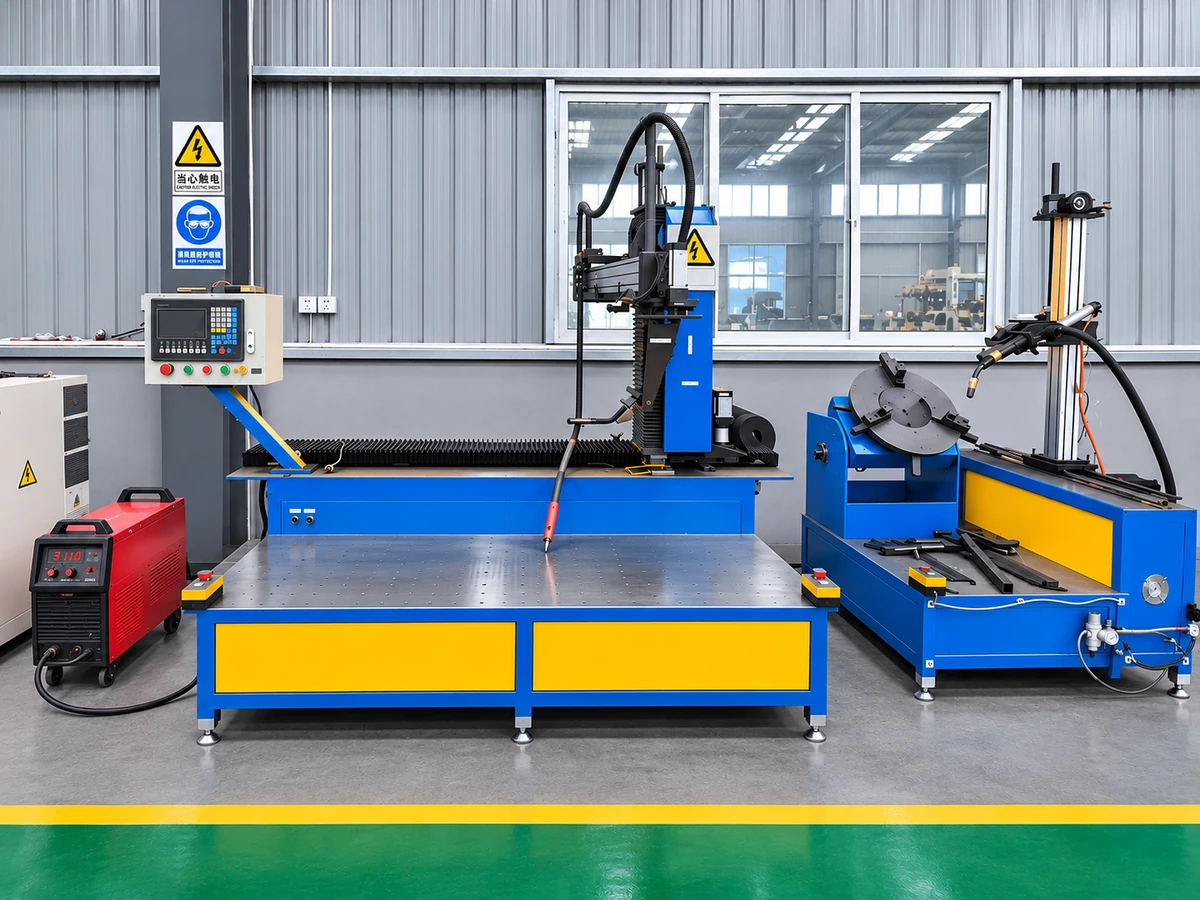
Key Engineering Advantages
- Uniform Structural Penetration: Synchronized torch speed, wire feed, and 360° rotary positioning eliminate cold laps and undercut on load-bearing towing seams.
- Batch Dimensional Repeatability (±0.2–0.5 mm): Pneumatic/toggle welding jigs + repeatable heat input keep pin holes aligned across thousands of frames.
- 2.2×–3.0× Higher Throughput: Ideal for scaling seasonal peaks in towing hitches, tractor 3-point adapters, snow pushers, and slab-lifter carts within our 35–40 days batch lead time.
Load-bearing assemblies in Trailer Towing, Agricultural & Robotic Welding and Utility Carts, Snow Removal & Municipal Equipment endure severe dynamic shock loads, tongue weight bending moments, and prying forces. A single cold weld on a 2-inch hitch receiver collar or tractor drawbar ear is an unacceptable safety liability. Here is how our automated CNC gantry and 360° rotary positioner welding stations compare with conventional manual welding inside our Manufacturing Services facility.
1. Technical Comparison: 360° Robotic/Gantry Welding vs. Manual MIG & TIG
| Evaluation Metric | Automated Gantry + 360° Rotary Welding | Manual Gas-Shielded MIG Welding | Manual Precision TIG Welding |
|---|---|---|---|
| Weld Penetration & Bead Uniformity | Consistent root fusion & fillet leg size across 100% of batch (AWS D1.1 / ISO 5817) | Operator-dependent; fatigue on late-shift heavy parts can cause variation | Clean, spatter-free bead; slower deposition on thick structural steel |
| Multi-Angle Joint Access | 360° turntable rotates part continuously into optimal flat/boat position | Requires manual flipping & crane re-clamping between faces | Excellent torch control in tight thin-sheet corners |
| Thermal Distortion Control | Repeatable travel speed & balanced programmed sequence minimize warp | Higher heat-input scatter requires more post-weld straightening | Low, localized heat on 0.8–3.0 mm stainless enclosures |
| Optimal Order Volume | Medium-to-high OEM batches (100 – 10,000+ pcs) | Prototypes, custom one-offs & small batches (1 – 80 pcs) | Cosmetic SUS304/316 housings, sanitary flanges & thin tubing |
| Post-Weld Spatter Cleanup | Low spatter pulse parameters; crisp bead ready for shot-blast & powder coat | Moderate spatter requiring manual chiseling/grinding before coating | Virtually zero spatter |
2. Why the 360° Rotary Positioner Matters for Hitches & Cart Frames
A fixed-table welding robot still struggles when welding around all four sides of a square hitch tube, a cylindrical axle sleeve, or a triangular 3-point tractor A-frame. Pairing an automated welding torch with a synchronized 360° rotary positioner turntable solves three critical fabrication challenges:
- Continuous Wrap-Around Seams: Circular collars, flanged bosses, and D-ring shackle mounts are welded in one continuous 360° rotation without start-stop craters at corners.
- Gravity-Assisted Weld Pool: Rotating the workpiece keeps molten steel in the flat or 45° horizontal-fillet position, allowing higher deposition rates and deeper root fusion without sag.
- Single-Clamping Cycle: Operators load laser-cut plates and CNC-turned sleeves into a precision pin-located fixture once, eliminating cumulative alignment error between faces.
3. Designing Welded Parts for Automated Fixture Repeatability
To maximize weld quality and lower unit cost, incorporate self-locating laser-cut tab-and-slot joints on gussets, maintain uniform fillet leg sizes where possible, and allow 2–3 mm machining stock on bores or faces that require ±0.01 mm post-weld CNC boring.
Procurement & Engineering FAQ
What minimum order quantity (MOQ) makes 360° robotic welding cost-effective?
For recurring OEM parts, robotic welding becomes highly economical starting around 100–200 units per batch (or 50+ units on multi-seam heavy hitch and tractor frames). We prototype initial 1–10 sample units using precision tacking fixtures and certified welders, then lock dedicated modular jigs onto our 360° rotary positioner station for volume runs.
How do you ensure deep weld penetration on thick Q355B hitch receiver tubes and forged bosses?
We bevel thick plate/boss joints prior to fit-up, program synergic pulse MIG parameters matched to wall thickness, use a synchronized 360° dual-axis rotary positioner to keep the weld pool in the optimal flat/horizontal gravity position, and verify weld root penetration per AWS D1.1 / ISO 5817 via macro-etch cross-section checks during FAI.
Can robotic welding and manual TIG welding be combined on the same OEM product?
Yes, hybrid routing is common. Long structural carbon-steel seams on cart chassis and receiver hitches run on automated gantry/rotary MIG cells for maximum strength and speed, while thin-wall stainless brackets or tight internal corners are finished by skilled TIG welders.
Send Your 2D/3D Drawings for Direct Source-Factory DFM Review & Quote
Explore our Manufacturing Services & Factory Audit Center to verify equipment envelopes and finishing lines, upload PDF, STEP/STP, IGES/IGS, DXF, or JPG/PNG files via Request a Quote, or message our engineering desk on WhatsApp. Every RFQ includes pre-quote DFM feedback, rapid prototyping support, and 35–40 days standard batch delivery.